
• Dentist Channel Online Dentist Channel Online
  • 13 April, 2022

General Anesthesia - Basics for Dental Professionals

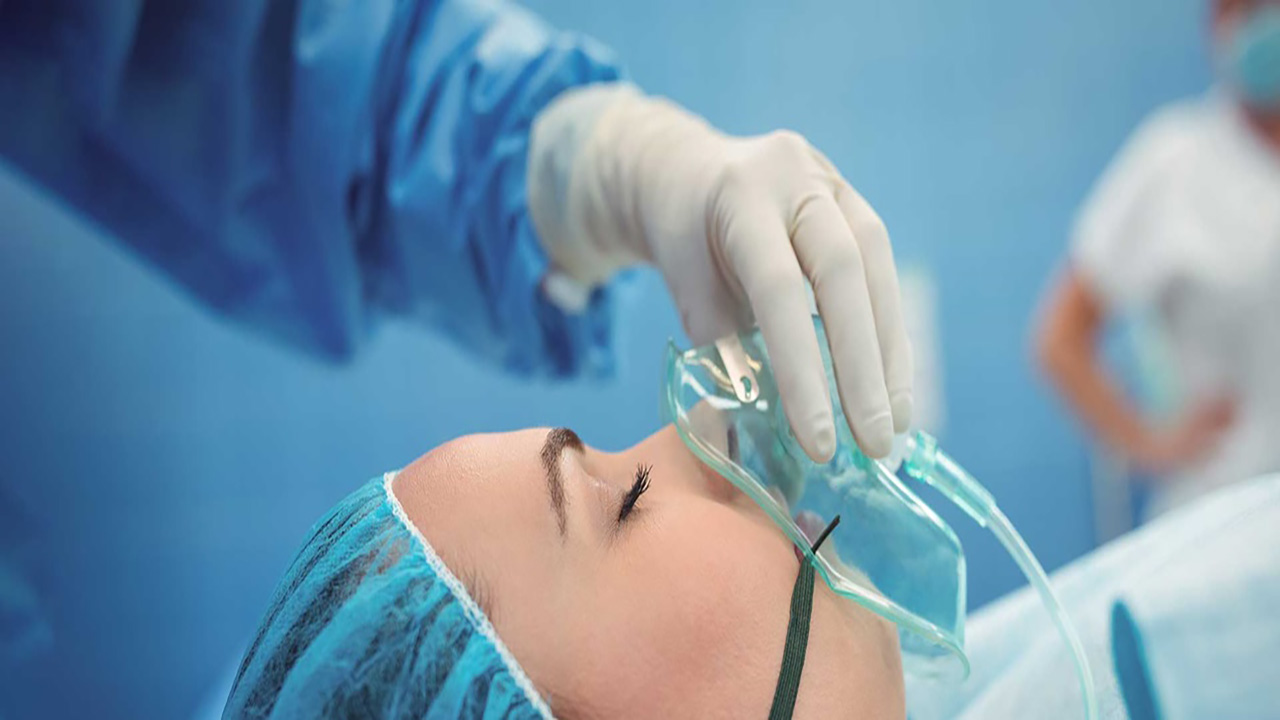
General anesthesia is a reversible state of central nervous system (CNS) depression, resulting in loss of response and perception of external stimuli. They depress the central nervous system and normal homeostatic reflexes to a sufficient degree to permit the performance of surgery and other noxious or unpleasant procedures.  

For patient General anesthesia should be:

  •  Pleasant
  •  Non irritating
  •  No nausea and vomiting
  •  Quick induction and recovery 

For surgeon General anesthesia should be:

  •  It should provide adequate analgesia, immobility, muscle relaxation
  •  Non inflammable and non explosive
  •  Blood gas solubility ratio in range of 0.3-2 

For anesthetist General anesthesia should be:

  •  Easy and controlled administration  
  •  Stable and easily stored
  •  Potent
  •  No major organ affected 

Mechanism of Action 

  • The molecular and cellular mechanisms by which general anesthetics produce their effects have remained one of the great mysteries of pharmacology. 
  •  For most of the 20th century, it was theorized that all anesthetics act by a common mechanism (the unitary theory of anesthesia).  
  • The leading unitary theory was that anesthesia is produced by perturbation of the physical properties of cell membranes.  
  • This thinking was based largely on the observation that the anesthetic potency of a gas correlated with its solubility in olive oil. 
  •  This correlation, referred to as the Meyer-Overton rule, was interpreted as implicating the lipid bilayer as the likely target of anesthetic action. 

Cellular Mechanisms of Anesthesia 

  • First, the inhalational anesthetics can hyperpolarize neurons.  
  •  It also may be important in synaptic communication, since reduced excitability in a postsynaptic neuron may diminish the likelihood that an action potential will be initiated in response to neurotransmitter release. Different anesthetic agents produce specific components of anesthesia by actions at different molecular targets. Given these insights, the unitary theory of anesthesia has been largely discarded.  
  • Second, at anesthetizing concentrations, both inhalational and intravenous anesthetics have substantial effects on synaptic transmission and much smaller effects on action-potential generation or propagation. 
  • The inhalational anesthetics inhibit excitatory synapses and enhance inhibitory synapses in various preparations.  
  • Inhalational anesthetics also can act postsynaptically, altering the response to released neurotransmitter.  
  • These actions are thought to be due to specific interactions of anesthetic agents with neurotransmitter receptors. 
  • IV anesthetics: Their predominant actions are at the synapse, where they have profound and relatively specific effects on the postsynaptic response to released neurotransmitter. 
  •  Most of the intravenous agents act predominantly by enhancing inhibitory neurotransmission, whereas ketamine predominantly inhibits excitatory neurotransmission at glutamatergic synapses. 

Molecular Actions of General Anesthetics 

  • A variety of ligand-gated ion channels, receptors and signal transduction proteins are modulated by general anesthetics.  
  • Of these, the strongest evidence for a direct effect of anesthetics exists for the GABAA and NMDA receptors and the two-pore K+ channels. 
  • Chloride channels gated by the inhibitory GABAA receptors are sensitive to clinical concentrations of a wide variety of anesthetics, including the halogenated inhalational agents and many intravenous agents (propofol, barbiturates, etomidate, and neurosteroids). 
  • At clinical concentrations, general anesthetics increase the sensitivity of the GABAA receptor to GABA, thus enhancing inhibitory neurotransmission and depressing nervous system activity. 
  • Glycine receptors may play a role in mediating inhibition by anesthetics. 
  • Glycine-gated chloride channels (glycine receptors):  play an important role in inhibitory neurotransmission in the spinal cord and brainstem. 
  • Propofol, neurosteroids, and barbiturates also potentiate glycine-activated currents, whereas etomidate and ketamine do not.
  • Ketamine, nitrous oxide, cyclopropane, and xenon : inhibit a different type of ligand-gated ion channel, the N-methyl-D-aspartate (NMDA) receptor. 
  • Halogenated inhalational anesthetics activate some members of a class of K+ channels known as two-pore domain channels. 


 Article by Dr. Siri P. B.
Categories:
Tags :
Comments :
Hailey Avatar
Hailey - 1 year ago
My name is Hailey Garcia and I am from New Jersey. My herpes virus turned to war after 2 years of living with it. I have tried different medical procedures to cure my herpes but to no avail. Most people think herpes is only a minor skin irritation of which herpes has long term effects on health and passes through the bloodstream and can be easily contracted through sexual intercourse. I knew I had herpes from the first day I started feeling itchy in my pubic area and the pain was very unbearable. I couldn't stand it anymore. After 2 years of trying other means to get rid of it, I had to contact Doctor Odunga to help me with a permanent cure. I saw his email and whats-app number from a testimony I read online from a lady who was also helped by him in curing infertility problems, I had faith and contacted him. He assured me of his work and I ordered his herbal medicine. Within 5 days, I didn't feel any pain anymore and within 2 weeks, my skin was all cleared and smooth. I am very grateful to you sir and I write this testimony as others have done to bring those having faith to you sir. If you have herpes or other similar disease and you want it cured, kindly contact Doctor Odunga, Whats-App (wa.me/+2348167159012) OR Email [email protected]

Authentication required

You must log in to post a comment.

Log in

Upcoming webinars:

  • 6 June,2026
Orofacial Pain & TMD: From Ambiguity to Accuracy

Advanced insights into diagnosing and managing temporomandibular disorders and orofacial pain with a focus on clinical accuracy and evidence-based care.

  • 8 June,2026
Metabolic syndrome and periodontitis

Explore the powerful link between metabolic syndrome and periodontitis, and learn how oral health influences overall systemic wellbeing

  • 10 June,2026
Building Resilience and Wellbeing in Modern Dental Practice

Building resilience and wellbeing strategies for modern dental professionals to manage stress, prevent burnout, and achieve a balanced clinical practice.

  • 12 June,2026
Taming the TMJ

Master TMJ management with expert insights on diagnosis, treatment planning, and advanced clinical approaches for temporomandibular disorders.

  • 13 June,2026
Obsession With the Apical Puff: The Science, The Myth & The Clinical Reality

An evidence-based webinar exploring the science, myths, and clinical significance of the apical puff in endodontic practice.

  • 15 June,2026
FMR: Restoring Function and Aesthetics

Advanced FMR session on Restoring function and aesthetics in complex Dental Cases.

  • 17 June,2026
From Chairside to Homeside : Finding Your Balance in Dentistry

Discover how to achieve a healthier work-life balance in dentistry by managing clinical practice, personal wellness, and life beyond the dental chair.

  • 20 June,2026
Minor Periodontal Surgeries

Practical, step-by-step approach to mastering common minor periodontal surgeries for predictable clinical outcomes in everyday dental practice.

  • 21 June,2026
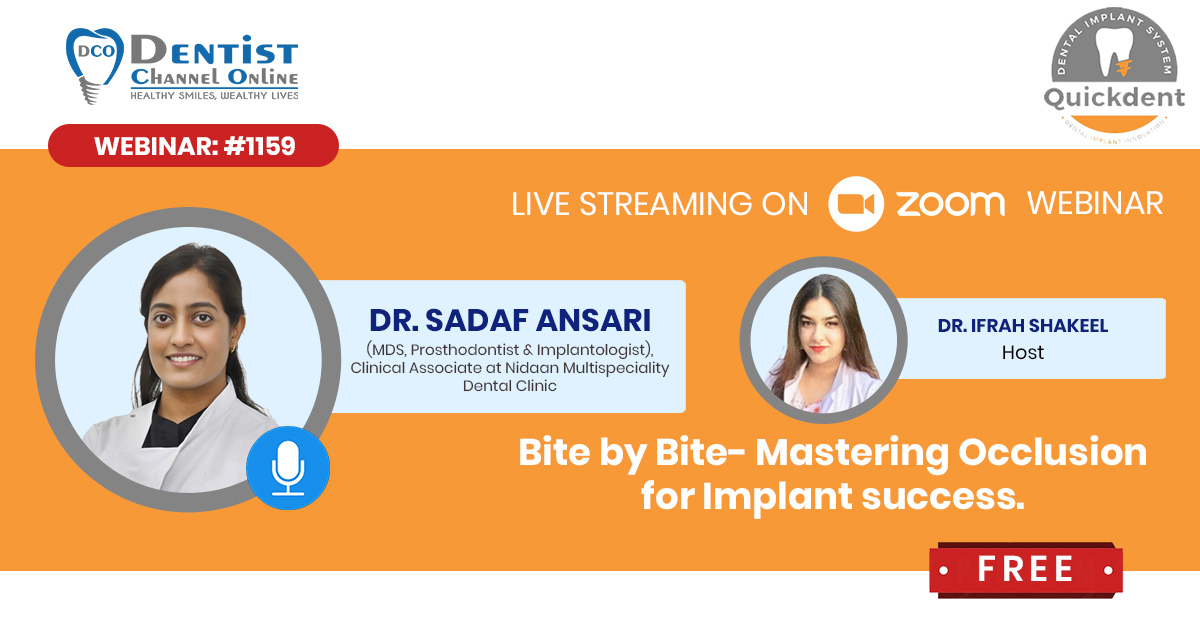
Bite by Bite- Mastering Occlusion for Implant success

Through this webinar, Master the occlusal principles that make or break implant success - because the bite determines the life of your implant